Care Funding Eligibility Checker: Understanding What You Could Be Entitled To
Discover what care funding you might qualify for in 2025/26. Understand capital thresholds, financial assessments, and your eligibility for council-funded and NHS-funded care.

1.2 million
People receive publicly-funded adult social care in England
3.9 million
People in England receive unpaid care from family
£14,250
Capital threshold 2025/26 for full local authority funding
£23,250
Capital threshold 2025/26 when self-funding begins
Understanding Care Funding in England
Care funding in England is complex, with different rules for different types of care and different sources of funding. Understanding who pays for what is the first step towards working out what you might be entitled to.
The Care Act 2014 and Your Rights: The Care Act 2014 is the law that sets out how care and support is organised in England. It establishes that everyone has the right to a free care needs assessment from their local authority, regardless of their finances or likelihood of funding. This assessment is a legal right, not a privilege. If the assessment concludes you have eligible care needs, you may qualify for local authority funding towards the cost of care.
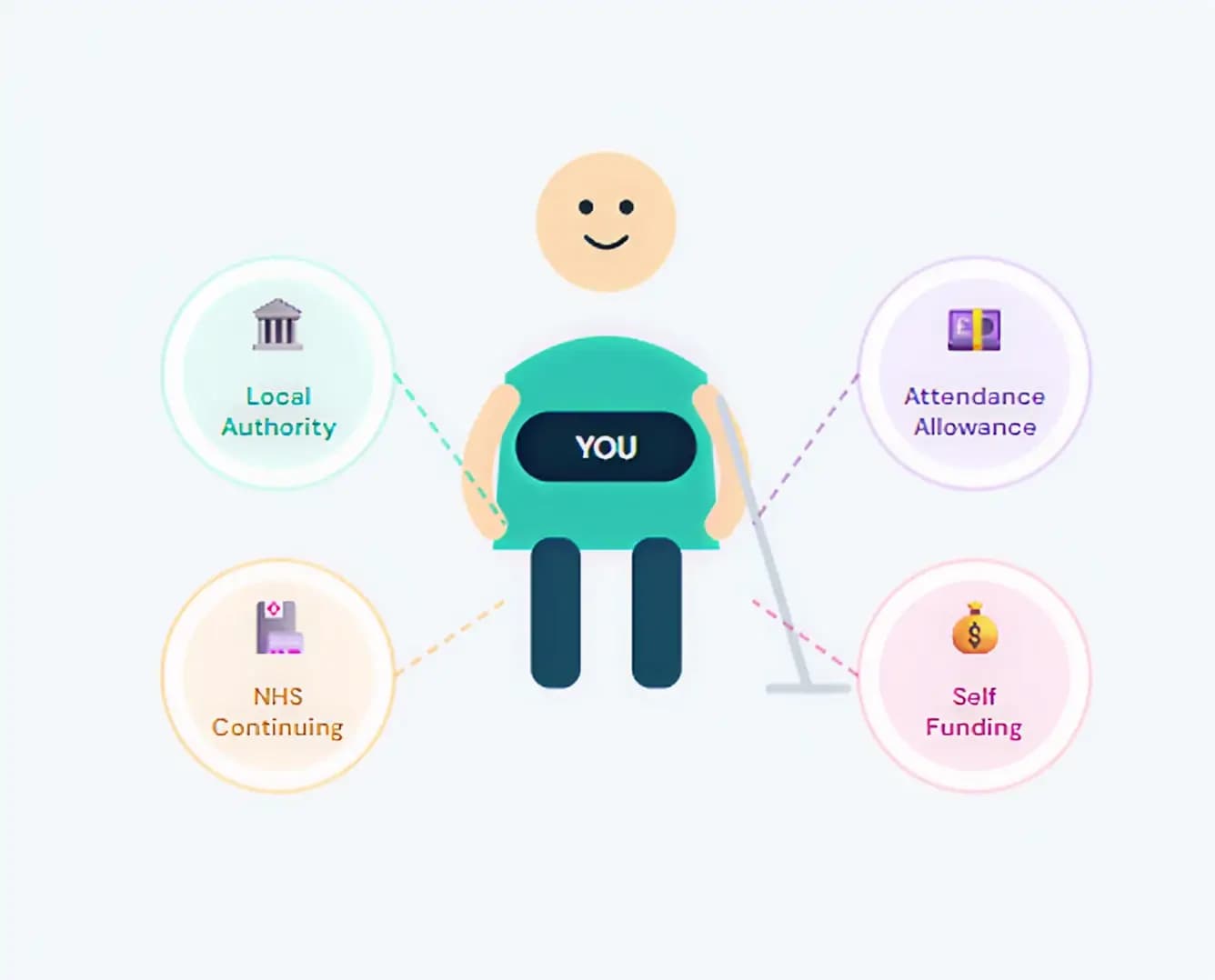
Who Pays for Care?
Care funding comes from three main sources, and understanding the difference is critical to claiming everything you're entitled to.
Local Authority Funding
means-tested based on capital and income
NHS Funding
For people with complex medical needs, not means-tested
Self-Funding
When savings exceed the thresholds
Attendance Allowance
Not means-tested, regardless of savings
The Process
How the Financial Assessment Works
A financial assessment determines how much you contribute towards care and how much the local authority pays. It examines your capital and income against specific thresholds.
What Is Included in the Assessment?
Capital Includes
- Investment properties
- Shares and unit trusts
- Money held in trust
- Lump sums from pensions or insurance
- Cash savings and premium bonds
Capital Includes
- Pension income
- Earnings from work (if employed)
- Interest from savings
- Benefits such as Attendance Allowance, PIP, or Carer's Allowance
- Rental income from property
What Is Disregarded (Not Counted)?
The financial assessment does not count everything. Several items are completely ignored:
- Your home, if you live in it and receive care at home (12-week period if in a care home)
- The first £14,250 of capital (this is completely ignored)
- Up to £23,250 of capital (tariff income is calculated from the remainder)
- Certain personal injury compensation payments
- Trusts set up before 8 April 1993 (generally)
- Your car (usually)
- Household items and personal possessions
How Is Contribution Calculated?
Your contribution is calculated using a simple formula:
- First £14,250 of capital: Ignored completely, you pay nothing based on savings
- Capital between £14,250 and £23,250: Tariff income of £1 per week for every £250 (or part thereof) above £14,250
- Above £23,250: You are expected to pay the full cost of care (self-funding threshold)
Example: If you have £20,000 in savings, the calculation is (20,000 minus 14,250) equals 5,750. This is divided by 250 and rounded up to 24 weeks of contribution, meaning you would contribute £1 per week for 24 weeks (£24 total) towards care costs.
2025/2026 Official Rates
Capital Thresholds That Apply Right Now
These are the official thresholds that apply for care funding decisions from 1 April 2025 onwards. They are updated annually in April. These thresholds apply to England only. Scotland, Wales and Northern Ireland have different rules.
- Fully Funded
Below Lower Threshold
£0–£14,250
Your savings are completely disregarded. Subject to eligible care needs, the local authority pays the full cost of your care. Your contribution is based on income only.
- Partial Funding
Middle Band
£14,251–£23,250
You contribute £1 per week for every £250 of savings above £14,250. This is called tariff income. The local authority funds the remaining cost of eligible care.
- Self-Funding
Above Upper Threshold
£23,250+
You pay the full cost of care yourself. Once your capital drops below £23,250, reapply for means-tested support. Benefits like Attendance Allowance may still apply.
Worked Examples
Understanding through examples makes it clearer:
Your Home and Care Funding
One of the most important aspects of care funding is how your home is treated. For most people receiving home care, the value of your property is completely ignored in the financial assessment. This is a significant advantage compared to care home funding.
Home Care: Your Property Is Protected
If you receive care at home (domiciliary care), the value of your property is entirely disregarded in the financial assessment. This means a homeowner with a house worth £400,000 and savings of £20,000 would be assessed only on the £20,000, not on their property value. Your home is considered essential for living and is protected from the means test.
Care Home: The 12-Week Disregard
If you move into a care home, different rules apply. For the first 12 weeks, the value of your home is disregarded (not counted). If you intend to return home or a spouse or dependent relative lives in it, the property remains disregarded for the entire duration of care home residence. After 12 weeks, if these conditions do not apply, your home enters the financial assessment.
Deferred Payment Agreements
If you need to move into a care home and your capital is above the self-funding threshold (£23,250), but most of your wealth is tied up in your property, you can request a deferred payment agreement (DPA) from your local authority. A DPA allows you to defer paying the care home costs by securing a charge against your home. This prevents forced house sales while care is being received.
Step-By-Step
Quick Eligibility Guide: Decision-Tree Style
Work through these steps to get an initial sense of whether you might qualify for local authority-funded care. This is a guide only — contact us for a full personalised assessment.
Are you 18+ and living in England?
Scotland, Wales and Northern Ireland have different care funding rules. This guide applies to England only.
Do you believe you have a care need (help with personal care, mobility, meals, medication)?
If no, you do not meet the first requirement. If yes, you are entitled to request a free care needs assessment from your local authority.
Has your local authority assessed you and found you have eligible care needs?
If no, you do not qualify for council-funded care yet. Consider arranging private care or appealing the decision. If yes, continue.
What is your total capital (savings, investments, property)?
A: Below £14,250: You likely qualify for full council funding (means-tested contribution based on income only). B: Between £14,251 and £23,250: You are in the partial funding band. You will contribute based on tariff income, and the council funds the remainder. C: Above £23,250: You are above the threshold and would self-fund. However, once capital drops below £23,250, reapply for means-tested support.
Attendance Allowance (AA)
Attendance Allowance is a benefit specifically designed to help people with the costs of personal care due to illness or disability. Unlike many other benefits, it is not means-tested, meaning your savings or income do not affect eligibility. If you qualify, you receive it alongside any local authority funding.
Who Can Claim Attendance Allowance?
- You must be State Pension age or over
- You must have needed help with personal care for at least 3 months (you can claim before this period ends)
- You must have a physical or mental illness, or disability
- You must be in Great Britain (not Northern Ireland)
Lower Rate
£72.65
per week
Daytime or night care needed — help during the day or regularly during the night, but not both.
Higher Rate
£110.40
per week
Around-the-clock care — help needed both day and night, or if you are terminally ill.
How to Claim
Call the helpline
0800 731 0122 — free to call. Monday to Friday.
Apply Online
Visit www.gov.uk/attendance-allowance to start your claim digitally.
Get help with your application
Citizens Advice and Age UK can help you complete the form — often this improves success rates.
NHS Continuing Healthcare (CHC)
NHS Continuing Healthcare is free care provided entirely by the NHS for people with complex, ongoing health needs. Unlike local authority-funded care (which is means-tested), CHC is not means-tested. If you are eligible, the NHS pays for all your care, whether at home or in a care home.
Who Qualifies for CHC?
The NHS uses a checklist covering 12 care domains:
- Breathing
- Drug therapies or medication
- Symptom control and pain management
- Psychological and emotional needs
- Nutrition and hydration
- Continence management
- Skin integrity and tissue viability
- Mobility
- Communication
- Cognition
- Behaviour
- Other considerations




Direct Payments
Direct Payments are a way for the local authority to give you money directly so you can arrange and pay for your own care, rather than the council arranging care on your behalf. This gives you full control and flexibility.
Who Can Receive Direct Payments?
- Anyone assessed as needing care from the local authority (children and adults)
- Carers entitled to support from the local authority
- People who lack capacity if an authorised representative consents on their behalf
How Do Direct Payments Work?
Once you are assessed as needing care, you can request Direct Payments instead of the council arranging care. Many people use Direct Payments to:
- Employ their own care workers directly
- Purchase care from private care agencies
Advantages of Direct Payments
- Greater control and choice over your care
- Flexibility to adjust arrangements as needs change
- Ability to employ carers you trust
- Often achieve better continuity of carer
- Can combine informal support from family with formal paid care
Responsibilities of Direct Payment Recipients
Direct Payments come with responsibilities. You become the employer and must:
- Keep financial records
- Ensure DBS checks are carried out on anyone providing care
- Pay employers' tax and National Insurance
- Ensure employment laws are followed
Support with Direct Payments
Many local authorities offer support with Direct Payments, including accountancy help. Some areas have Direct Payment support organisations that help with payroll and employment responsibilities. Your local authority can tell you what is available.
Other Funding Sources
Beyond local authority and NHS funding, several other benefits and grants can help towards care costs.

Carer's Allowance
If you are providing care to someone, you may qualify for Carer's Allowance if you care for at least 35 hours per week and your earnings are below £199 per week. The rate is £81.90 per week (2025/26). This can contribute towards care costs if the carer is struggling financially.
Personal Independence Payment (PIP)
If you are under State Pension age and have a long-term health condition or disability affecting your ability to complete daily tasks or move around, you may qualify for PIP. The payment is not means-tested and can reach £627.60 per month (enhanced rate, 2025/26). PIP can be used towards any costs, including care.
Council Tax Discount for Carers
If you are a full-time unpaid carer looking after someone, you may qualify for a council tax discount. Many councils offer at least 25% discount or exemption. Contact your local council for details.
Disabled Facilities Grant (DFG)
If you need adaptations to your home to continue receiving care at home (ramp, wet room, stair lift), you may qualify for a Disabled Facilities Grant from your local council. This can fund adaptations without means testing or loan repayment for owner-occupiers with capital below £30,000.
Charitable Grants
Several charities and trusts offer grants to help older people and disabled people with care costs. These include:
- The Henry Smith Charity
- The Anchor Trust
- Elizabeth Finn Care
- The Turn 2 Us Grants Database (searchable online at www.turn2us.org.uk)
Self-Funding and Getting Value for Money
Capital above £23,250 means self-funding. But that doesn't mean you're on your own — or that you can't get great value and support.
- 01
Budget carefully
Work out how long your funds need to last and calculate sustainable weekly spend
- 02
Negotiate rates
Do not accept the first quote; care agencies often have flexibility on pricing
- 03
Look for quality, not just price
Cheapest is not always best; CQC ratings are free to check online
- 04
Consider time-banking
Some communities offer time-banking where you get help in exchange for helping others
- 05
Explore hybrid funding
Even if council-funding does not apply, you might still claim Attendance Allowance or other benefits
- 06
Keep receipts
Self-funded care may have tax relief implications; keep good records
Getting Help with Your Funding Application
The care funding system is complex, and many families benefit from professional guidance. Support is available from several sources, many free of charge.

Age UK
Age UK offers free, impartial advice on care funding, benefits, and your rights. Their Advice Line is 0800 169 6565 (Monday to Friday, 9am to 5pm). They can explain your options, help with applications, and support appeals.
Citizens Advice
Citizens Advice provides free advice on benefits, care funding, and legal rights. Visit www.citizensadvice.org.uk to find your local office or contact the Citizens Advice Consumer Service for specific queries.
Your Local Authority Adult Services
Do not underestimate the help available from your local authority. They have a duty to explain the assessment and funding process to you. Ask for a written explanation of how your contribution has been calculated. If you disagree, ask about the appeals process
Hertfordshire
In Hertfordshire, contact Hertfordshire County Council Adult Services on 01438 843000 or visit www.hertfordshire.gov.uk/adult-services for care funding guidance.
Cambridgeshire
In Cambridgeshire, contact Cambridgeshire County Council on 01223 632010 or visit www.cambridgeshire.gov.uk for care support and funding information.
Living Plus Care Services
At Living Plus Care Services, we are familiar with the funding system and can discuss your options when you contact us. If you are above the threshold for local authority funding, we can arrange private care. If you are below it, we work alongside council-funded packages. Call us to discuss your situation.
Ready to Understand Your Care Funding Options?
Get a free assessment and personalised guidance on your care funding eligibility. Our care advisors can explain your options and help you access the support you may be entitled to.
Book Free Assessment: www.livingpluscare.co.uk/contact