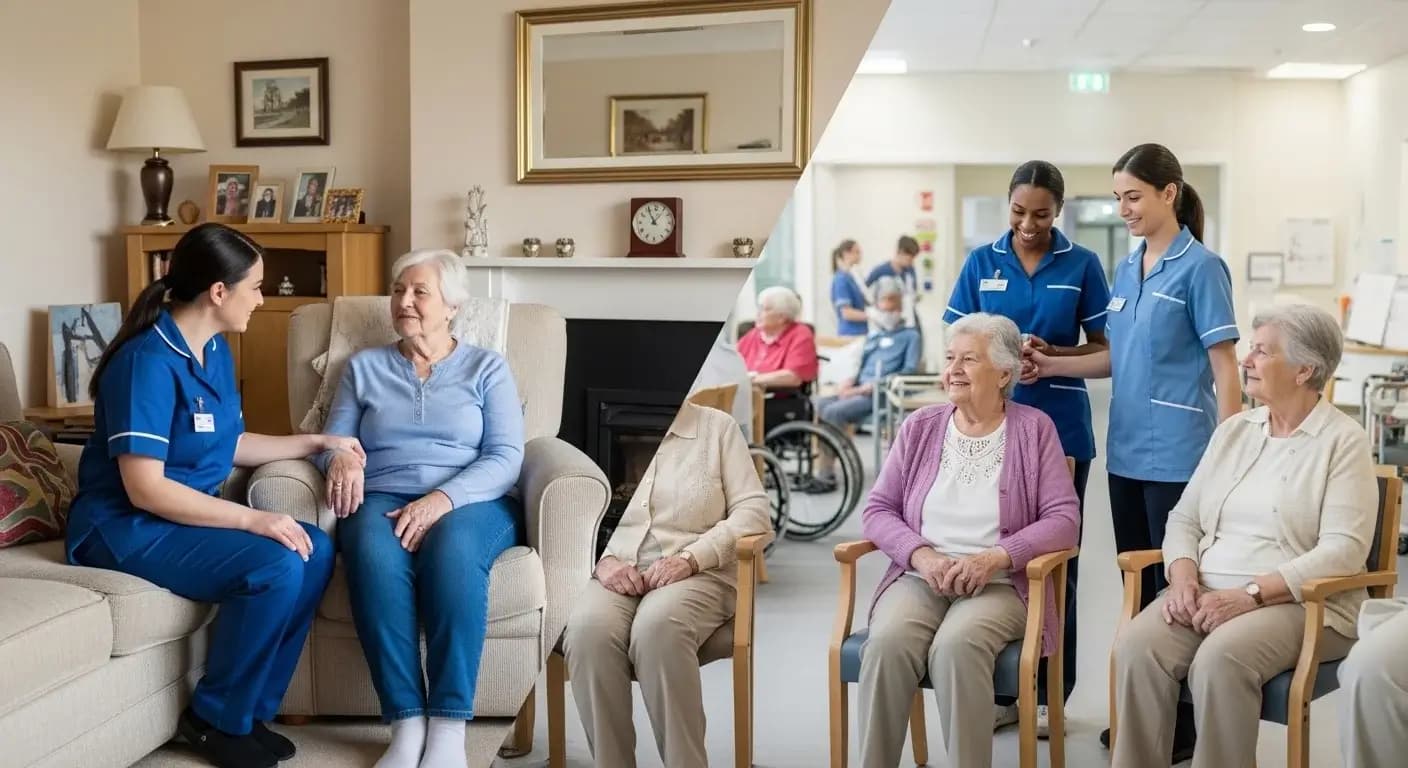
Home Care Vs Care Home
Home Care vs Care Home: Making the Right Choice for Your Loved One
A comprehensive guide to understanding your options, comparing costs and lifestyle, and making the decision that works best for your family.
~1.1 million
People receive home care across the UK
~380,000
People live in care homes in the UK
70%
Prefer to age in place at home if possible
Price difference
Home care saves 20-40% vs care home
Understanding Your Options
When care becomes necessary, families face a significant decision: should your loved one stay at home with support, or move into a care home? There is no single right answer. Both options have genuine advantages and disadvantages, and the best choice depends on individual circumstances, health needs, personal preferences, family support, and financial situation.
This guide walks you through both options, helps you compare them directly, and provides a structured framework for making the decision that will work best for your family.

The Key Question
The choice between home care and care home is fundamentally about balancing independence and autonomy against the structured support and social environment of communal living. Most people prefer home care initially, but as care needs increase or social isolation becomes a concern, a care home may become more suitable.
Side-by-Side Comparison Table
This table covers the key practical differences between home care and residential care homes across ten important dimensions.
| Aspect | Home Care | Care Home |
|---|---|---|
| Independence | You maintain full control of your home, routines, and decisions. Carers adapt to your schedule and preferences. | More structured routines and rules set by the home. Less choice about daily timetables, meals, or bedtimes. |
| Cost Structure | Pay only for the hours of care used. Hourly rates typically GBP26-GBP32/hour (2025/26). | Fixed weekly fee covering all care, meals, accommodation. Typically GBP600-GBP1,500 per week. |
| Social Life | Depends on visitors, community activities, and carer companionship. May be isolated if family live far away. | Built-in social environment with other residents. Activities and entertainment organised by the home. |
| Personalisation | Your home remains yours. You choose how it looks, what happens when, and with whom you interact. | Shared facilities. Limited scope for personalisation of your room or communal areas. |
| Home Environment | Familiar surroundings, cherished possessions, memories embedded in your home. Comfort of privacy. | Institutional setting. Must leave home and downsize possessions. Can feel impersonal. |
| Flexibility | Highly flexible. Increase or decrease hours as needs change. Easy to adjust support plans. | Less flexible. Care packages are set. Changing needs may mean moving homes or higher fees. |
| Property Implications | Your home is excluded from the means test. Homeowners often qualify for council funding even with significant assets. | Home is included in the financial assessment after 12 weeks. May need to sell home to fund care. |
| 24-Hour Support | Available but expensive. Live-in care costs GBP1,200-GBP1,500/week. Overnight care adds significant cost. | Always available as standard. No extra cost for night support; included in the weekly fee. |
| Specialist Care | Good for low to moderate needs. Complex medical needs may be harder to manage safely at home alone. | Better equipped for high-dependency care, multiple health conditions, and behavioural support. |
| Carer Continuity | Best providers ensure same carers visit regularly. Builds trust and understanding of individual needs. | Staff turnover is common. May see different carers daily. Less personal continuity for dementia. |
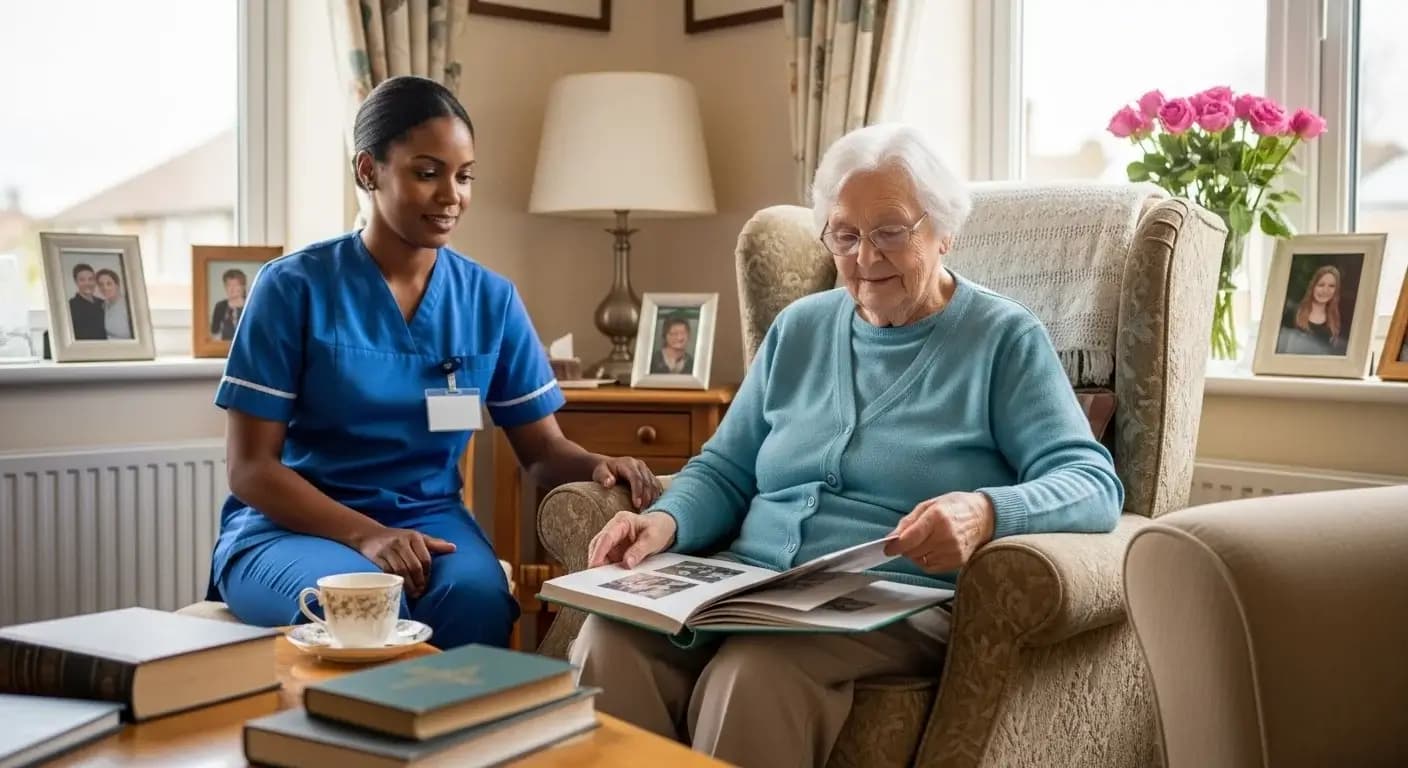
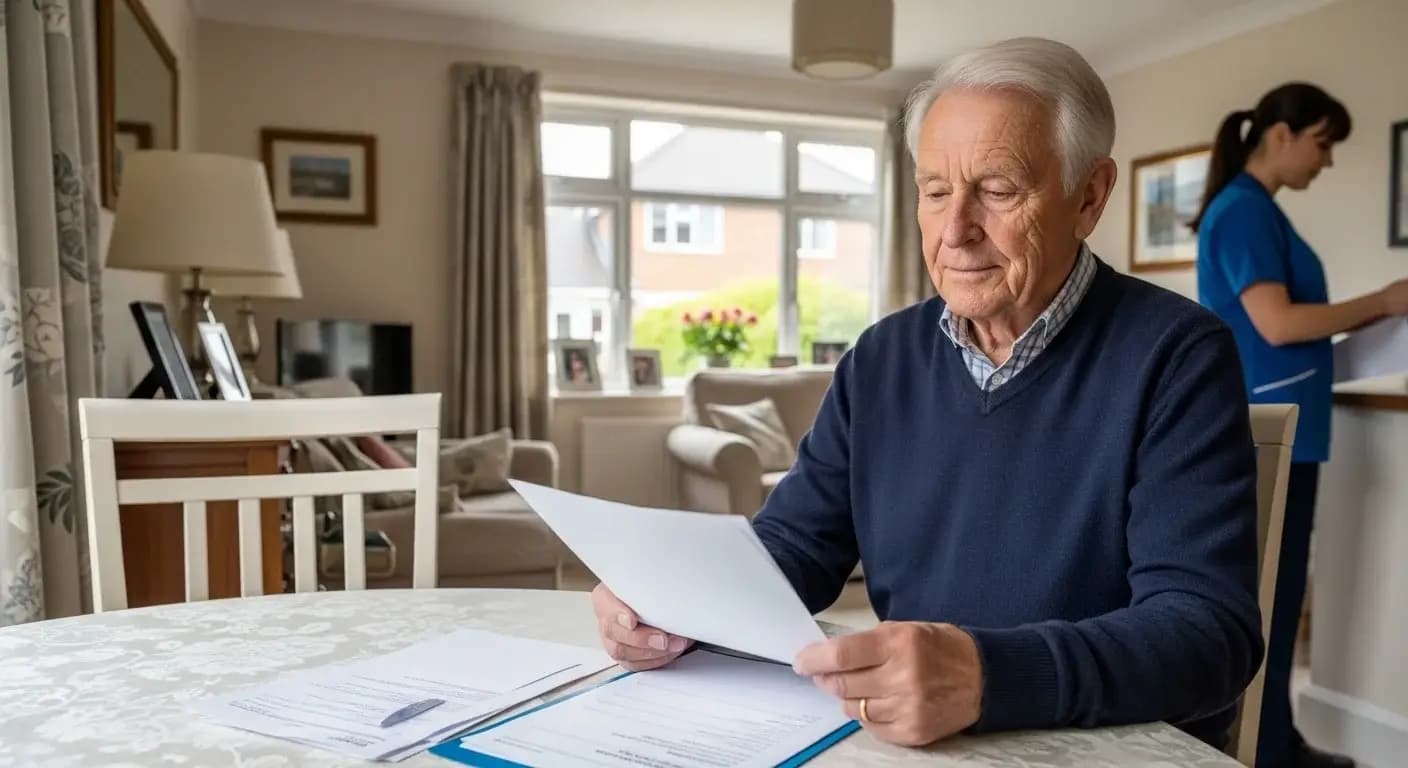
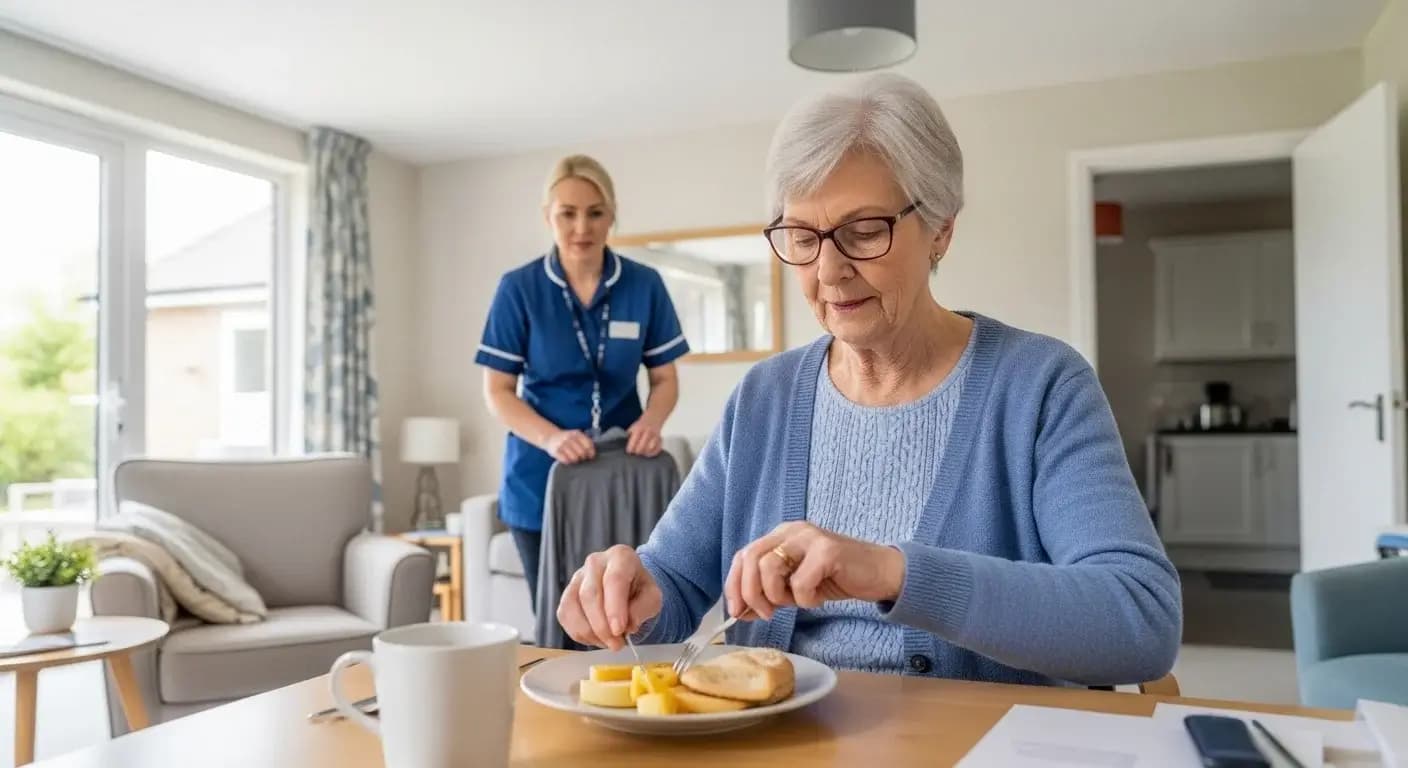
When Home Care Is the Better Choice
Home care is typically the best option when:
Low to Moderate Care Needs
If someone needs help with personal care (washing, dressing, medication) but can manage meals, social interaction, and mobility reasonably well, home care works very effectively. There is no benefit to paying full care home fees when you only need 2-3 hours of care per day.
Strong Preference to Remain at Home
Many people express a clear wish to stay in their own home. This desire is not irrational; research shows that remaining in familiar surroundings supports wellbeing, reduces anxiety, and often helps preserve cognitive function in older people. Honouring this preference, where practical, is important.
Family Support Available
When family members can visit regularly, provide companionship, make medical appointments, and oversee care, home care becomes much more viable. The combination of professional carers plus engaged family often provides better continuity and emotional support than a care home.
Sufficient Social Networks
If the person has friends nearby, attends a day centre, volunteers, or has regular community involvement, isolation is less of a concern. Home carers provide practical support; community connection provides social and emotional support.
Property-Rich, Cash-Poor Situation
For homeowners without substantial liquid savings, home care is financially advantageous. Your home is excluded from the council means test, meaning you can often access council-funded care. In a care home, the home would be included in the financial assessment after 12 weeks, potentially forcing sale.
Desire for Autonomy and Control
Some people value independence highly and find the structured environment of a care home claustrophobic, even if it offers good care. These individuals often thrive with home care, retaining control over their daily life.



When a Care Home May Be More Suitable
A care home may be the better option when:
Very High Care Needs
When someone requires 24-hour support, including night-time assistance with toileting, mobility, or health monitoring, a care home is often safer and more practical. Twenty-four-hour live-in care is extremely expensive (GBP1,200-GBP1,500 per week) and leaves the person dependent on a single carer. Care homes spread support across multiple staff.
Complex Medical Needs
For people with multiple health conditions, unstable diabetes, advanced dementia requiring frequent intervention, or palliative care needs, the constant availability of trained staff in a care home is safer. Care homes have protocols for medical emergencies, medication management, and coordination with NHS services.
Significant Isolation or Loneliness
When someone lives alone, has no family nearby, and has lost their social networks, loneliness can become a serious health risk. A care home provides constant human contact and built-in social activities. This can be life-transforming for socially isolated individuals.
Safety Concerns at Home
For people with advanced dementia who attempt to wander, or those with severe cognitive decline who forget to take medication or leave the stove on, a home environment may be unsafe regardless of care hours. A locked, secure care home environment removes these risks.
Carer Exhaustion
Family carers often reach a breaking point where they are providing 12+ hours of unpaid care daily. This is unsustainable and damaging to their own health. Moving to a care home can preserve the family relationship by removing the burden of daily hands-on care.
Dementia Care in Advanced Stages
Care homes specialising in dementia provide secure environments, structured activities, reminiscence therapy, and staff trained in managing behavioural changes. For late-stage dementia, this specialist support is often superior to home care.
Need for Ongoing Medical Monitoring
Nursing homes (not just residential care homes) have qualified nurses on staff for constant monitoring, wound care, catheter management, and medication administration. These services are essential for people with advanced Parkinson's, motor neurone disease, or post-stroke recovery.
Detailed Cost Comparison
Understanding the financial picture is crucial. Below are realistic UK costs for 2025/26 across different care options.
| Care Type | Weekly Cost (2025/26) | Annual Cost |
|---|---|---|
| Visiting Home Care (2 hrs daily) | GBP336-GBP448 | GBP17,472-GBP23,296 |
| Visiting Home Care (4 hrs daily) | GBP672-GBP896 | GBP34,944-GBP46,592 |
| Live-in Home Care | GBP1,200-GBP1,500 | GBP62,400-GBP78,000 |
| Residential Care Home | GBP600-GBP900 | GBP31,200-GBP46,800 |
| Nursing Home (with nursing staff) | GBP900-GBP1,400 | GBP46,800-GBP72,800 |
| Specialised Dementia Home | GBP700-GBP1,200 | GBP36,400-GBP62,400 |
Breaking Down the Costs
Visiting home care
Typical costs range from GBP26-GBP32 per hour nationally in 2025/26. A 2-hour daily visit (personal care in morning) costs approximately GBP48-GBP64 per day, or GBP336-GBP448 weekly. Costs are higher in London and the South East.
Live-in home care
One live-in carer costs approximately GBP170-GBP215 per day depending on experience and location. This is a fixed arrangement where the carer lives in the home full-time. Complex care or multiple health conditions may cost more. Overnight-only care (carer sleeps but available for night needs) costs GBP210-GBP260 per night.
Care homes
Residential care homes (no nursing staff) typically cost GBP600-GBP900 per week nationally, covering accommodation, meals, personal care, and activities. Nursing homes with qualified nurses on site cost GBP900-GBP1,400 per week. Specialist dementia homes charge at the higher end. Costs vary by region; care in coastal towns or rural areas is often cheaper than urban areas.
Cost Reality Check
For someone needing 24-hour support, home care quickly becomes more expensive than a care home. However, for people with modest care needs, home care saves significant money. For property-owning homeowners, the financial assessment differences are even more important than hourly costs.For someone needing 24-hour support, home care quickly becomes more expensive than a care home. However, for people with modest care needs, home care saves significant money. For property-owning homeowners, the financial assessment differences are even more important than hourly costs.
The Financial Assessment Difference: Home Care vs Care Home
This is the most important financial difference between the two options. Understanding how the council assesses your assets can save your family tens of thousands of pounds.
Home Care: Property is Disregarded
If you receive domiciliary care at home, the value of your property is completely excluded from the council's financial assessment. This is the key rule that makes home care financially attractive for homeowners. Even if your home is worth GBP400,000, GBP600,000, or more, it is disregarded. Only your savings, investments, and liquid assets count towards the GBP14,250-GBP23,250 thresholds.
Example: A homeowner in Hatfield with a home worth GBP450,000 and savings of GBP18,000 would be in the GBP14,250-GBP23,250 band and would contribute GBP1 per week for every GBP250 of savings above GBP14,250. The property is completely ignored.
Care Home: Property is Included (After 12 Weeks)
If someone moves into a residential care home, the value of their property is included in the financial assessment. There is a temporary disregard for the first 12 weeks (sometimes extended to 52 weeks if the person is taking steps to sell), but after that, if the property has not been sold, it counts fully towards the means test.
This has major implications. If a person moves into a care home at GBP800 per week (GBP41,600 annually), their property would be counted. If the property is valued at GBP400,000, combined with modest savings, they would almost certainly exceed the GBP23,250 threshold and be expected to self-fund. Over a few years, the costs can force the sale of the family home.
The Mathematical Impact
For a GBP400,000 home with GBP20,000 savings: home care at GBP32/hour with 3 hours daily support costs approximately GBP33,600 annually. The person likely qualifies for council funding. A care home at GBP800 weekly (GBP41,600 annually) would likely require full self-funding because the property is included, potentially costing GBP41,600 per year until the property is sold, or indefinitely if the family decides not to sell.
Strategic Implications
This is why many families strategically choose home care for their parents, even if a care home might seem easier. The financial advantages of property disregard can be substantial, especially for families who wish to preserve the property as an inheritance.
Always Seek Advice
Every family situation is different. Speak to an independent financial adviser or your local authority's care assessment team before making decisions based on property implications. Some situations (very complex needs, no family support, advanced dementia) may make a care home the right choice despite the financial impact.
Quality and Regulation
Both home care agencies and care homes are regulated by the Care Quality Commission (CQC) in England, ensuring standards of safety, quality, and care.
CQC Inspection Process
The CQC rates both home care agencies and care homes using five key questions: Is it safe? Is it effective? Is it caring? Is it responsive? Is it well-led? Every provider receives a rating of Outstanding, Good, Requires Improvement, or Inadequate. Inspection reports are public and available on the CQC website
Home Care Agency Inspection
Home care agencies are typically inspected once every 2-3 years, unless previous ratings suggest more frequent monitoring is needed. The CQC looks at staff training, safeguarding procedures, management of medication, and feedback from service users. CQC inspectors may visit some of the homes where carers are working.
Care Home Inspection
Care homes are inspected at least annually (more frequently if rated Requires Improvement or Inadequate). CQC inspectors spend considerable time on site, interview residents and staff, review care plans, and assess daily practices and mealtimes.
Checking Ratings
Before choosing either option, always:
- Visit the CQC website and search for the provider by name or location
- Read the full inspection report, paying attention to any areas marked Requires Improvement or Inadequate
- Look for patterns; a single weakness may be corrected; repeated issues suggest systemic problems
- Check when the last inspection took place (if over 2 years ago, a new inspection may be imminent)
- Read feedback from current and former service users
For Living Plus Care Services, our Hatfield branch in Hertfordshire is rated Good by the CQC. You can view our full inspection report on the CQC website.
Making the Decision: Step-by-Step Framework
Making this choice can feel overwhelming. Here is a structured approach to help your family reach a decision that everyone can support.
Step 1: Assess Care Needs Honestly
The first step is understanding what care is actually needed. Is it help with personal care once daily? Companionship to prevent isolation? 24-hour monitoring due to dementia? Specialist nursing care? Your local authority can provide a free care needs assessment. A private home care provider can also conduct a free assessment.
Stage 2: Explore Funding Options
Contact your local council's adult social services and ask for a care needs assessment and a financial assessment. Know what funding you would receive. Then contact a private home care provider and get a price for the care needed. Compare the full picture. Sometimes council-funded home care is possible; sometimes not. Knowing this is crucial.
Stage 3: Consider Personal Preferences
What does the person in need of care actually want? This matters. Some people desperately want to remain at home; others worry about isolation and would welcome the social environment of a care home. These preferences should weigh heavily in your decision. Forcing someone into a care home against their wishes often leads to depression and poor outcomes.
Stage 4: Assess Available Family Support
Be honest about family involvement. Can family visit 2-3 times per week? Can you manage healthcare appointments, financial affairs, and emotional support? Or will the person be largely alone? If isolated, a care home may provide better day-to-day human contact. If family is deeply involved, home care often works better.
Step 5: Evaluate Safety and Practical Factors
Home care requires a safe, suitable home. Is the house damp, difficult to heat, or inaccessible to a wheelchair? Does someone living alone with advanced dementia risk leaving the stove on or wandering? These practical concerns may make a care home necessary regardless of preference.
Step 6: Try Home Care First
If considering either option, try home care first. It is lower commitment; you can start with a few hours weekly and adjust as needed. If after 3-6 months home care is not working (carer relationships break down, needs exceed available hours, isolation becomes a problem), you can reassess and move to a care home. Moving to a home is a bigger step with more consequences, so starting with home care is usually sensible.
Step 7: Trial the Arrangement
If considering a specific care home, most allow trial days where the person can spend time in the home, have a meal, and meet staff. Trial periods (sometimes a few weeks) can help determine if it is a good fit before committing fully.
Step 8: Plan for Flexibility
Care needs change. Someone might start with home care and later need to move to a home. Or initially choose a home and later discover that a different arrangement works better. Build flexibility into your plan and revisit the decision annually.
Key Questions to Ask Yourself and Your Family
Why is care needed? What does the person in need of care actually prefer? Can we realistically provide or support home care? Is isolation a concern? Are there safety risks at home? What can we afford? How often can family visit? Are we prepared to make changes if the first choice is not working? What outcome would make everyone feel confident in the decision?
The Third Option: Live-in Care
Live-in care deserves special attention because it represents a genuine middle ground between visiting home care and residential care homes. A live-in carer lives in the person's home full-time, providing 24-hour support whilst allowing the person to remain in their own environment.
What Live-in Care Involves
A live-in carer typically occupies a bedroom in the service user's home and provides all personal care, meals, medication, and companionship. They are on-call throughout the night (though not necessarily awake). The carer may have one or two days off per week, covered by a second carer. It is genuinely round-the-clock support.
When Live-in Care Works Well
Live-in care is ideal for people with complex care needs who want to remain at home, have family nearby to oversee arrangements, and can afford the cost (GBP1,200-GBP1,500 weekly). It is especially suitable for people with dementia, as having the same carer continuously significantly reduces anxiety and helps maintain routine. It also works well for people with significant mobility needs or those recovering from illness who want to avoid the institutional environment of a care home.
Advantages
- Remains in own home with familiar surroundings
- Consistent carer provides continuity and trust-building
- Greater flexibility than a care home; maintain own routines
- 24-hour support available without the cost of two live-in carers
- Property disregard applies (like visiting home care); advantageous for financial assessment
- Family oversight possible; maintain involvement in decisions
Disadvantages
- Cost is substantial; may exceed some care home costs
- Requires a suitable home (spare bedroom, sufficient space)
- Less opportunity for social engagement with others; depends on family/carer for all interaction
- Staff turnover can affect continuity
- If carer becomes unavailable, cover arrangements must exist
- More isolation than a care home despite 24-hour support
Is Live-in Care Right for You?
Consider live-in care if: complex care needs require constant availability, the person insists on remaining home and has means to fund it, a suitable bedroom is available, family can still be involved in oversight, and social isolation is manageable through regular family visits or activities.
Local Options: Hatfield and Peterborough
Living Plus Care Services provides CQC-registered home care across two branches. We can support your decision by conducting a free, no-obligation care assessment and helping you understand whether home care is viable for your situation
Hatfield, Hertfordshire
Our Hatfield branch is rated Good by the Care Quality Commission and provides home care across Hatfield, Welwyn Garden City, St Albans, Potters Bar, Brookmans Park, and surrounding villages in Hertfordshire. We work closely with Hertfordshire County Council and local NHS services. We can arrange everything from a few hours of companionship weekly to 24-hour live-in care.
Call our Hatfield team: 01707 707599
CQC Rating: Good
Peterborough, Cambridgeshire
Our Peterborough branch covers Peterborough and surrounding areas of Cambridgeshire, providing the same high standard of CQC-registered home care. We work alongside Cambridgeshire County Council and local health services.
Call our Peterborough team: 01733 911656
Local Authority Contacts
To request a free care needs assessment from your local council:
- Hertfordshire County Council Adult Services: www.hertfordshire.gov.uk/services/adult-social-services
- Cambridgeshire County Council Adult Services: www.cambridgeshire.gov.uk/residents/adults/adults-services
Both councils can advise on council-funded home care and provide financial assessments at no cost.
Next Steps
Whether you are exploring home care, considering a care home, or uncertain which direction to take, start with a free assessment. Call Living Plus Care Services or your local council. There is no commitment; it is simply a conversation to understand what options are realistic for your situation.
Unsure Which Option Is Right? Let's Talk.
A free, no-obligation care assessment helps you understand your options and make the right choice for your family. Our experienced care advisors will discuss your situation, explore what home care could look like, and answer all your questions.
Book Free Carer Consultation: www.livingpluscare.co.uk/contact